TDEE & Macro Calculator
Find out how many calories you burn per day and get exact calorie and macro targets for cutting, maintaining, or lean bulking — based on the Mifflin-St Jeor equation.
BMR
1746kcal
burned at complete rest
TDEE
2707kcal
your daily maintenance
Daily targets by goal
Cut
≈1 lb / 0.5 kg lost per week
2207kcal
154 g protein
261 g carbs
61 g fat
Maintain
hold current weight
2707kcal
154 g protein
354 g carbs
75 g fat
Lean bulk
slow, mostly-muscle gain
3007kcal
154 g protein
409 g carbs
84 g fat
Macros use 2 g protein per kg of bodyweight and 25% of calories from fat, with the remainder from carbs — a solid default you can adjust to preference.
BMR vs TDEE: what's the difference?
Your BMR (basal metabolic rate) is what your body burns doing nothing — keeping your heart beating, brain running, and body warm. Your TDEE adds everything on top: workouts, walking to the car, fidgeting at your desk. For anyone planning their nutrition, TDEE is the number that matters — it's the line between losing, holding, and gaining weight.
The activity multiplier is where most people go wrong: training hard 4 days a week but sitting the other 23 hours a day is "moderately active," not "very active." When in doubt, pick the lower level — it's easier to add calories later than to explain a stalled cut.
How to use your numbers
- Cutting: eat at the cut target, keep protein high, and keep lifting heavy — the training signal is what tells your body to burn fat instead of muscle.
- Maintaining: eat at TDEE and focus on performance. Recomposition (gaining muscle while holding weight) works best for newer lifters and those returning from a break.
- Lean bulking: a small surplus beats a big one. If you gain more than ~0.5% of bodyweight per week, most of the extra is fat.
- Recalculate after every 10 lb / 5 kg of weight change, or when your activity level genuinely shifts.
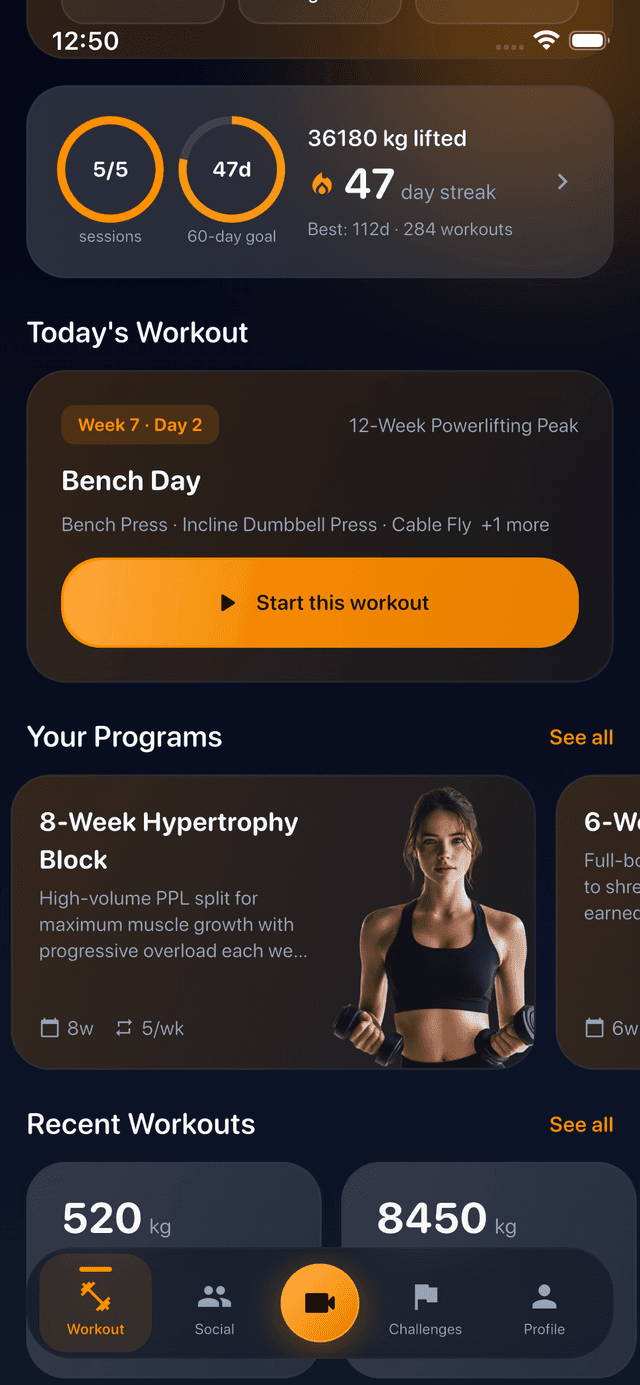
Calories are half the equation
The other half is training. DilFit tracks every set, shows you the numbers to beat, and keeps your streak alive with friends and challenges — so the calories you eat build something.
Get App for FreeFrequently asked questions
What is TDEE?
TDEE (total daily energy expenditure) is the number of calories you burn in a full day — your resting metabolism (BMR) plus everything else: training, walking, digestion, and daily movement. Eat at your TDEE and your weight holds steady; eat below it and you lose; eat above it and you gain.
How is TDEE calculated?
This calculator uses the Mifflin-St Jeor equation, the most accurate general-purpose BMR formula in validation studies, then multiplies by an activity factor (1.2 for sedentary up to 1.9 for extremely active) to account for training and daily movement.
How accurate is a TDEE calculator?
Any formula is a starting estimate — real metabolisms vary. Treat the number as a first draft: eat at your calculated target for 2–3 weeks while tracking bodyweight, then adjust by 100–200 calories based on what the scale actually does.
How big should my calorie deficit or surplus be?
A 500-calorie daily deficit produces roughly 1 lb (0.5 kg) of loss per week — aggressive but sustainable for most. For muscle gain, a 200–300 calorie surplus keeps the gain mostly lean; bigger surpluses mostly add fat.
How much protein do I need?
For people who lift, research supports 1.6–2.2 g per kg of bodyweight per day (about 0.7–1 g per lb). This calculator uses 2 g/kg — enough to maximize muscle retention in a deficit and growth in a surplus.