One Rep Max Calculator
Estimate your 1RM for squat, bench press, deadlift, or any lift from a submaximal set — no risky max attempt required. Enter the weight and reps from a recent hard set and get your estimated max plus training loads for every rep range.
Estimated one rep max
155lb
Epley
157.5 lb
Brzycki
152 lb
Lombardi
158.5 lb
O'Conner
152 lb
Your training loads by % of 1RM
| % of 1RM | Weight | ~Max reps | Typical goal |
|---|---|---|---|
| 100% | 155 lb | 1 | Max strength / testing |
| 95% | 145 lb | 2 | Strength |
| 90% | 140 lb | 4 | Strength |
| 85% | 130 lb | 6 | Strength / hypertrophy |
| 80% | 125 lb | 8 | Hypertrophy |
| 75% | 115 lb | 10 | Hypertrophy |
| 70% | 110 lb | 12 | Hypertrophy / endurance |
| 65% | 100 lb | 15 | Endurance |
| 60% | 95 lb | 20+ | Endurance / technique |
How this 1RM calculator works
No formula perfectly predicts a max for every lifter and every exercise, so instead of picking one, this calculator averages four of the most validated equations in strength research:
Epley: 1RM = weight × (1 + reps ÷ 30) — the most widely used formula, slightly generous at higher reps.
Brzycki: 1RM = weight × 36 ÷ (37 − reps) — very accurate in the 1–10 rep range, conservative beyond it.
Lombardi: 1RM = weight × reps^0.10 — a power-curve model that stays conservative at high reps.
O'Conner: 1RM = weight × (1 + 0.025 × reps) — a linear model popular for upper-body lifts.
How to get an accurate estimate
The quality of the estimate depends entirely on the set you feed it. For the best result:
- Use a recent set taken close to failure — a set you could only have done one or two more reps on.
- Prefer low-rep sets (2–5 reps); they track true maxes far better than sets of 12–15.
- Use sets performed fresh, early in a session — a grinding fifth set underestimates your max.
- Estimate per exercise. Your squat, bench, and deadlift each need their own number; percentages don't transfer between lifts.
Why train with percentages of 1RM?
Nearly every proven strength program — 5/3/1, Texas Method, Smolov, GZCLP — prescribes weights as percentages of your max. That's because intensity relative to your capacity, not absolute load, is what drives adaptation. Training at 85% of 1RM produces a different stimulus than 70%, whether your max is 100 lb or 500 lb. Knowing your 1RM turns "lift heavy" into an exact target for every session, and updating it as you get stronger is the simplest way to guarantee progressive overload.
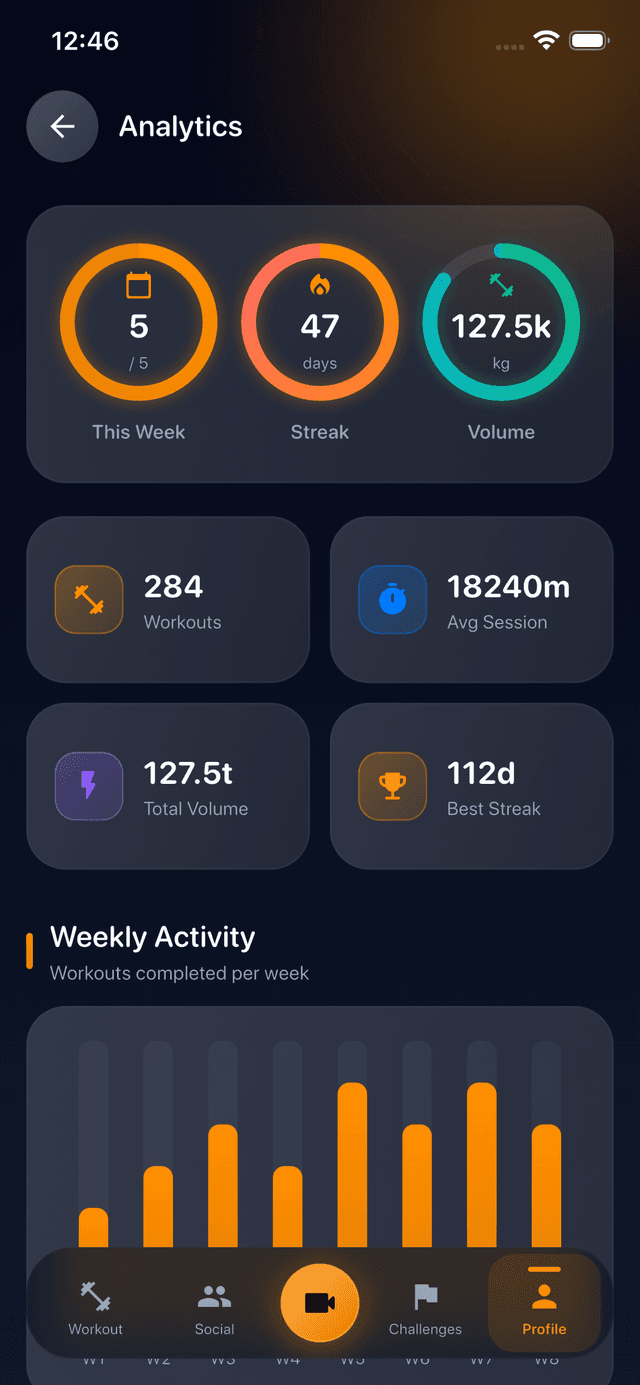
Track your 1RM automatically
DilFit estimates your one rep max from every working set you log — no max-out days needed. Watch your strength trend over time, hit PRs, and share them with your training crew.
Get App for FreeFrequently asked questions
What is a one rep max (1RM)?
Your one rep max is the heaviest weight you can lift for a single repetition of an exercise with proper form. It's the standard measure of maximal strength and the reference point most training programs use to prescribe working weights (e.g. "squat 5×5 at 80% of 1RM").
How accurate are 1RM calculators?
Estimates from a set of 2–5 reps are typically within 2–5% of a true tested max. Accuracy drops as reps increase — beyond 10 reps the formulas diverge noticeably, which is why this calculator averages four established formulas (Epley, Brzycki, Lombardi, and O'Conner) and caps input at 15 reps.
Do I need to actually test my true 1RM?
For most lifters, no. Testing a true max is fatiguing and carries injury risk without a spotter and solid technique. An estimated 1RM from a hard set of 3–5 reps gives you everything you need to program training percentages safely.
How often should I recalculate my 1RM?
Every 4–8 weeks, or whenever a working set feels noticeably easier than prescribed. If you log your sets in a tracker like DilFit, you can watch your estimated 1RM trend upward from your everyday working sets without ever maxing out.
What percentage of my 1RM should I train at?
It depends on your goal: roughly 85–100% for maximal strength (1–6 reps), 70–85% for muscle growth (6–12 reps), and 60–70% for muscular endurance (12+ reps). The table under the calculator converts your estimate into exact loads for each zone.