Full Body vs Upper/Lower vs Push/Pull/Legs: The Beginner's Guide to Training Splits
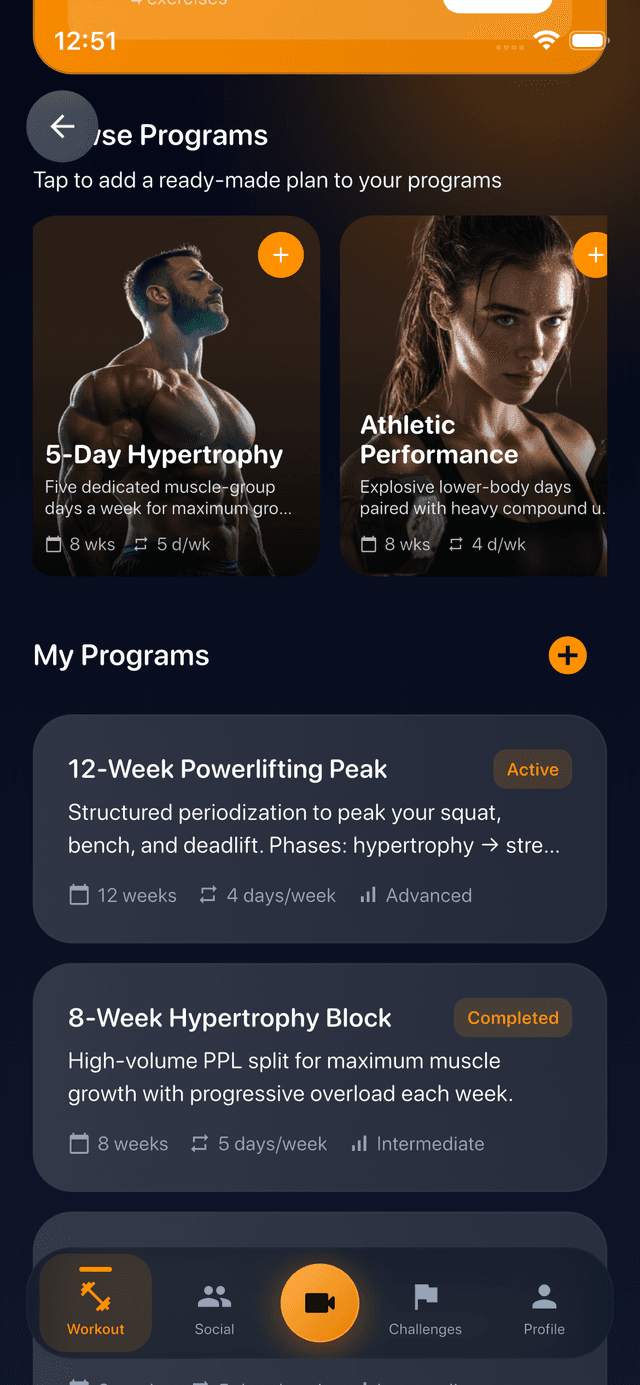
Track this directly in DilFit
DilFit makes logging workout records, monitoring strength metrics, sharing progressive routines, and training alongside partners effortless. Beautiful layouts, custom graphs and full social tracking at your fingertips.
Get App for FreeA training split is just the answer to one question: how do you divide your body's muscles across your training week? Get it roughly right and everything downstream — exercise selection, recovery, progress — gets easier. Get it wrong (usually by copying someone with a completely different schedule) and you'll spin your wheels no matter how hard you train.
One principle sorts most of the debate: research consistently favors training each muscle group at least twice per week over the classic once-a-week "bro split," even when total volume is equal. Every split below respects that rule. From there, the right choice comes down to two things — how many days you can actually train, and how much volume you can recover from.
The three splits at a glance
| Full Body | Upper / Lower | Push / Pull / Legs | |
|---|---|---|---|
| Days per week | 2–3 | 4 | 5–6 |
| Frequency per muscle | 2–3× per week | 2× per week | 2× per week (6-day version) |
| Typical session | 45–75 min | 45–60 min | 45–60 min |
| Best for | Beginners and busy schedules | Intermediates with a steady week | Committed lifters chasing volume |
| Watch out for | Sessions ballooning as volume grows | Stacked fatigue on lower days | Muscles trained only 1× per week if run 3 days |
Full body: the default that's hard to beat
Every session trains everything: a squat pattern, a press, a pull, and a couple of accessories. On 2–3 days per week, each muscle still gets hit two or three times — frequency that no other split can match on that schedule. It's the best starting point for beginners (more practice on the big lifts per week) and the best fallback for anyone whose calendar is unpredictable. A simple week: Monday full body A, Wednesday full body B, Friday full body A — alternating A/B so exercises rotate.
Upper/lower: the intermediate workhorse
Four days, split in half: upper body Monday and Thursday, lower body Tuesday and Friday. Each muscle keeps its twice-weekly frequency, but every session now has room for more sets per muscle than a full-body day allows — which matters once beginner gains slow and volume becomes the growth lever. It's also the most forgiving structure: miss one day and you've still trained everything that week.
Push/pull/legs: the volume split
Push (chest, shoulders, triceps), pull (back, biceps), legs — run twice through for a six-day week. Each muscle group gets a dedicated session with high volume and full focus, while still hitting the twice-a-week frequency target. The catch is the commitment: run PPL on only three days and each muscle drops to once a week, which quietly turns it into the bro split it was meant to replace. Six days works; three days doesn't.
How to choose (and stick)
Count your realistic training days — realistic meaning the weeks work is busy, not your best-case week. 2–3 days: full body. 4 days: upper/lower. 5–6 days: push/pull/legs, or upper/lower plus an extra day if you're newer to training. Still unsure? Our workout split quiz at dilfitness.com/tools/workout-split-quiz walks you through it in three questions.
The mistakes that sink every split
1. Split-hopping. No split shows results in two weeks. Commit for 8–12 weeks, progress the weights, then evaluate.
2. Copying advanced volume. The influencer's 25 sets per muscle works because of years of adaptation (and often more). Start at 10–15 hard sets per muscle per week and earn more.
3. Ignoring recovery. Sleep and food decide whether a 6-day split builds you up or grinds you down. If performance drops two weeks running, cut a day before cutting effort.
4. Not logging. The split is the plan; the log is the proof. Track every set — weight, reps, and how it felt — and let last week's numbers set this week's targets. That habit, more than the split itself, is what separates people who progress from people who just attend.